AI Confidence Affirmations: Believable 7-Day Checklist

Boost Your Confidence with AI-Powered Affirmations (That Actually Feel Believable)
Confidence grows fastest when self-talk becomes intentional and consistent—not when it’s loud or dramatic, but when it’s specific enough to feel true on a normal Tuesday. A printable checklist turns affirmations into a simple daily practice, while AI helps you generate wording that sounds like you (not like a poster on a wall). Over time, that combination makes the habit easier to keep, more believable to repeat, and more likely to show up as real action.
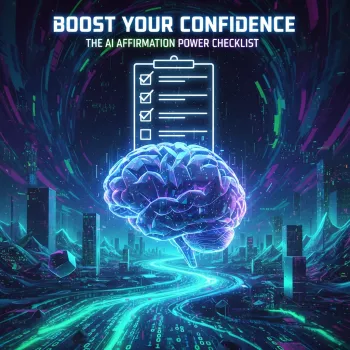
If you like structured steps, Boost Your Confidence: The AI Affirmation Power Checklist (digital self-confidence guide) is designed to be printed or used on a phone/tablet so you can create, test, and refine a small set of confidence statements without overthinking.
What changes when affirmations are specific (and not generic)
Generic affirmations often backfire because the brain treats them like a claim that needs evidence. If the statement feels unrealistic, it’s easy to dismiss it—sometimes with extra sarcasm. Specific affirmations reduce that resistance by tying confidence to a real situation you’ll actually face: a meeting, a first date, a workout, a creative post, or a boundary-setting conversation.
The goal isn’t hype. It’s “true enough” language that you can repeat without wincing. That believability matters because repetition works best when it feels like training rather than pretending. A short routine done daily compounds more than an intense routine you quit after three days.
This approach lines up with established ideas about how self-affirmation can support behavior change by reinforcing values and identity—see Self-affirmation theory for a high-level overview. For broader confidence-building guidance, the American Psychological Association’s self-esteem resources also emphasize practical, repeatable habits.
The AI Affirmation Power Checklist: what it is and how it fits into a day
The checklist is a digital self-confidence guide you can print or use on a tablet/phone. Instead of asking you to “just think positive,” it gives you a sequence: choose a focus area, generate options with AI support, select the most believable line, repeat it briefly, and track whether you followed through.
Because it’s a checklist, it fits into small moments:
- Morning planning: pick a focus (social, work, body, consistency) and set a one-sentence intention.
- Pre-event prep: use a 60-second version right before the meeting, gym session, or call.
- Evening reset: repeat once, then note one action you took even if you felt nervous.
For anyone pairing mindset work with career goals like interviews, networking, or presentations, the Step-by-Step Career Development Guide (professional growth ebook) complements a confidence routine by giving you concrete preparation steps to back up your affirmations with evidence.
How to use AI to generate affirmations that feel personal
AI is most helpful when you give it a narrow target. Start with one confidence goal defined by three parts:
- Context (where): “team meeting,” “party,” “gym,” “client call,” “date,” “posting my art.”
- Behavior (what): “ask one question,” “share my idea,” “hold eye contact,” “finish the set,” “send the email.”
- Emotion (how it should feel): “calm,” “steady,” “curious,” “grounded,” “capable.”
Then add constraints that prevent exaggerated wording:
- Tone: calm, assertive, encouraging, matter-of-fact.
- Length: one sentence (so it’s easy to repeat).
- Realism: avoid absolutes like “always,” “never,” “perfect.”
Ask for variations that match different moments: one line for before the action, one for during, one for after. Pick 1–3 statements and run a short trial (3–7 days). Constantly switching lines can become a form of avoidance—like you’re shopping for the “perfect” sentence instead of practicing.
If you want the wording to be more behavior-based (and less pressure-heavy), borrow a page from cognitive behavioral therapy’s focus on practical skills and reframes; this CBT overview explains the basics.
Ready-to-copy AI request templates for confidence affirmations
| Use case | What to provide AI | Example affirmation style |
|---|---|---|
| Speaking up at work | Meeting type, topic, what feels risky, how to contribute | “My ideas are worth sharing, and I can say them clearly and calmly.” |
| Social plans | Where you’re going, what you worry about, how you want to act | “I can be present, ask one good question, and let conversations unfold.” |
| Trying something new | Activity, skill level, fear of judgment, next small step | “Beginners learn by doing; I can take one step and improve from there.” |
| Body confidence | What you want to appreciate, what your body helps you do today | “My body supports my life, and I treat it with respect and patience.” |
Make affirmations stick: a simple 7-day confidence loop
Common pitfalls (and quick fixes)
Printable mindset booster: ideas for tracking without overthinking
If your routine happens on the go (commute, gym, travel), having reliable power can remove friction. A practical option for busy days is the 120W Fast Charging Power Bank 50000mAh for Samsung so your notes or checklist are always accessible when you need a quick reset.
Digital guide details and who it suits best
FAQ
Do AI-generated affirmations work if they’re not “from the heart”?
They can, as long as the statement is relevant, believable, and repeated consistently. AI helps you generate options quickly, but the results work best when you choose and edit the lines until they feel personally true.
How many affirmations should be used each day for confidence?
One to three is plenty, especially when they’re tied to one situation. Consistency (same time daily, paired with a cue) tends to matter more than adding more statements.
What if an affirmation feels fake or triggers resistance?
Soften the wording (“I’m learning,” “I’m practicing”) and anchor it to a controllable behavior you can actually do today. Keep the same line for a few days before changing it, and revise until it feels realistic.





Leave a comment